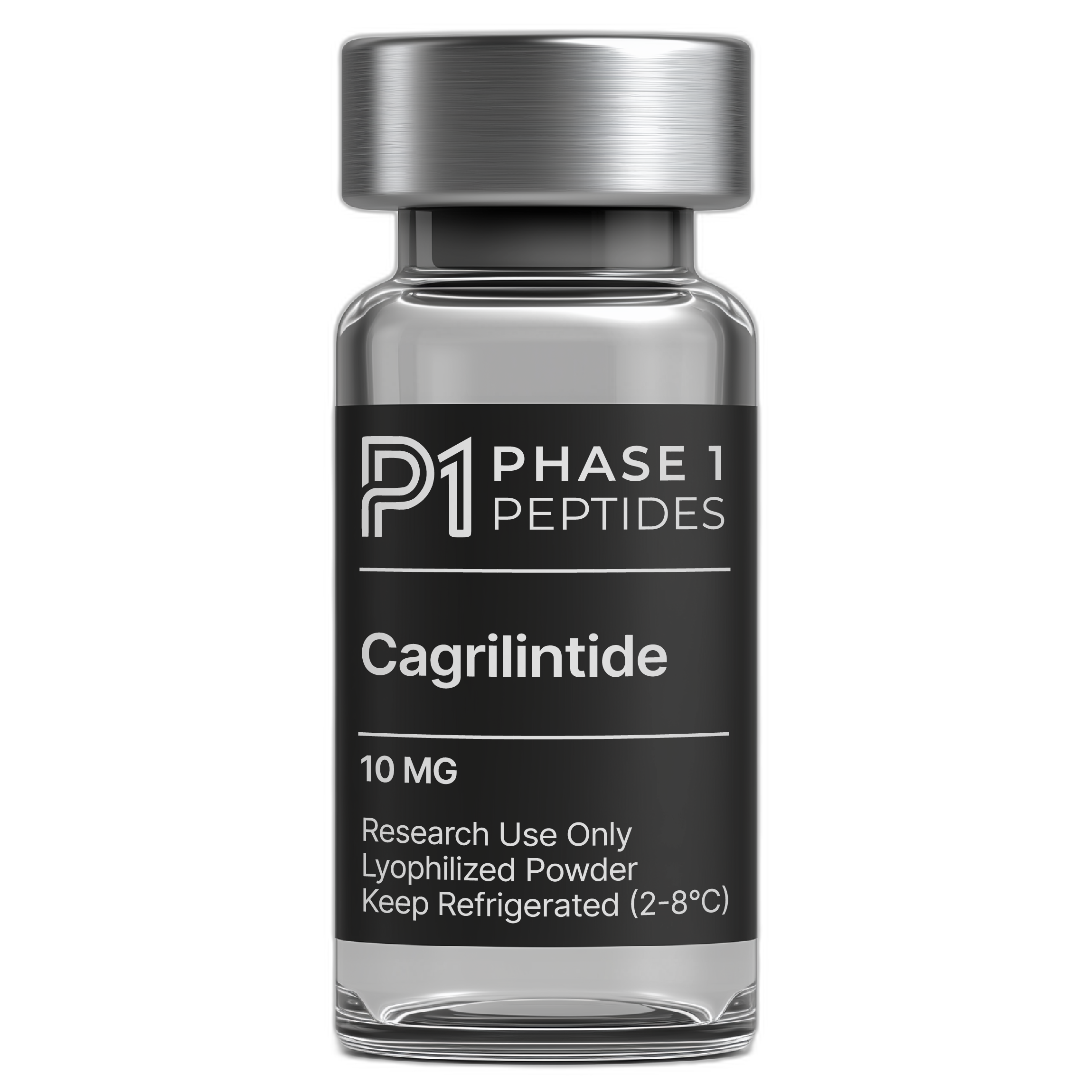
Cagrilintide
A long-acting amylin analogue peptide studied in metabolic research involving receptor-mediated signaling pathways related to energy homeostasis. Its extended half-life makes it particularly useful in laboratory studies examining sustained amylin receptor activation and downstream metabolic effects.
Cagrilintide Overview
Cagrilintide is a long-acting peptide analogue of amylin studied in metabolic research. In laboratory and clinical research settings, it is used to examine amylin-related signaling and how this pathway interacts with broader metabolic regulation systems.
Mechanism of Action & Applications
Cagrilintide is studied for agonist activity at amylin and calcitonin-family receptor systems. Research has examined how this receptor activity influences downstream signaling involved in metabolic regulation, making it useful in studies of amylin biology, receptor pharmacology, and multi-pathway metabolic signaling. More recent structural work has also described how cagrilintide engages these receptors through an amylin-like binding mode while producing distinct receptor conformations and dynamics.
Research History
Cagrilintide emerged from efforts to develop a longer-acting amylin analogue with improved stability and sustained receptor activity. Published medicinal chemistry work in 2021 described its development as a stable, lipidated long-acting amylin analogue, and later studies further characterized its receptor activity and structural behavior.
Chemical Information
- CAS Number
- 1415456-99-3
- Molecular Formula
- C194H312N54O59S2
- Molecular Weight
- 4,409 g/mol
- PubChem ID
- 167312356
For research use only. Not for human or veterinary use. Detailed storage guidelines →
Often Paired With
Researchers who buy Cagrilintide commonly stock these alongside it.

Researcher Reviews